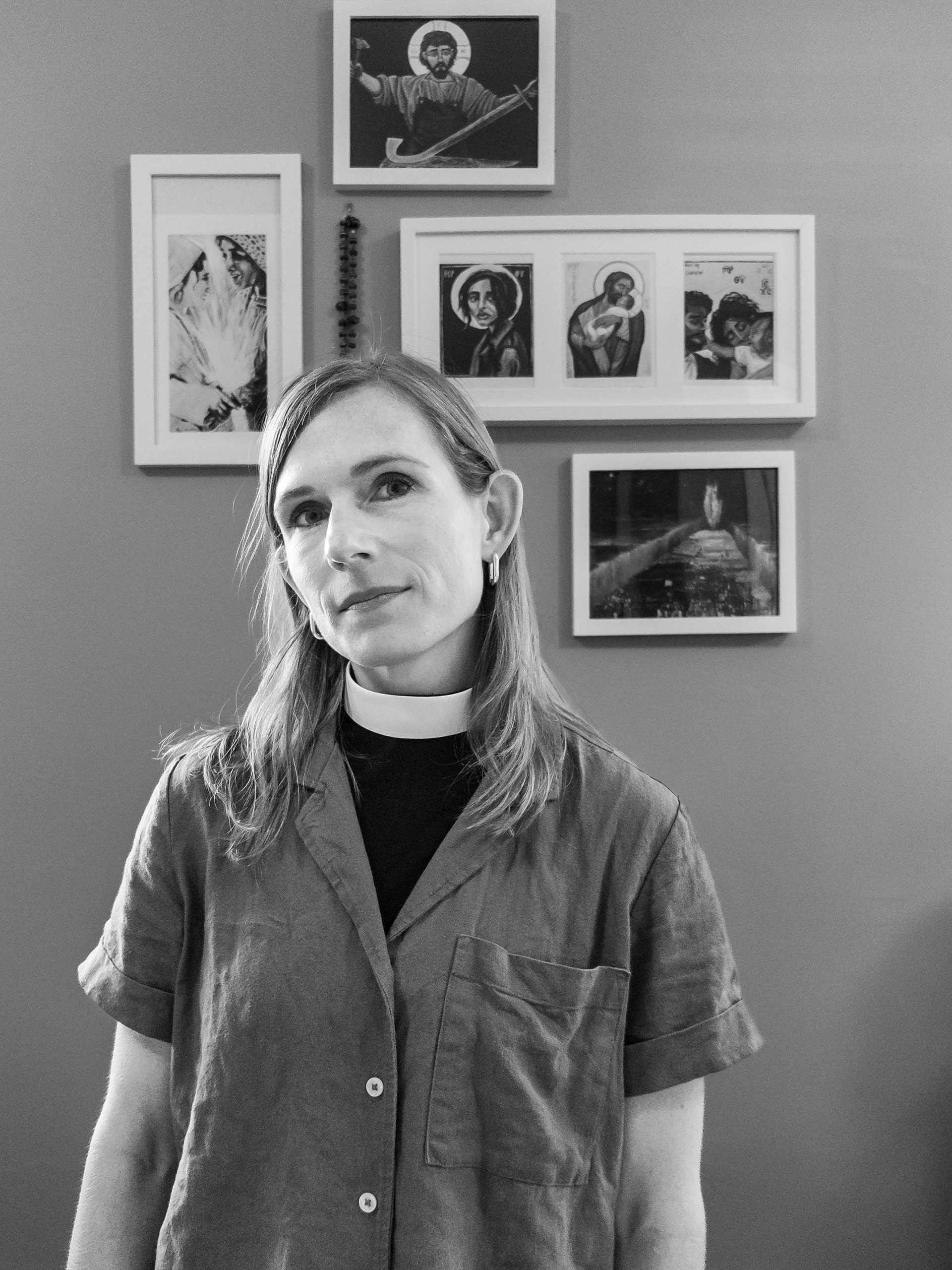
Juliet San Nicolas de Bradley
Hello everyone and welcome to Call and Response, the storytelling project where we hear the story of women and their call to holy orders. I'm joined today by Amanda. Would you introduce yourself?
Amanda
Yes, my name is Amanda, and I am the rector.
Juliet San Nicolas de Bradley
So our first question here is if you could just tell us a little bit of the story of your call to ministry.
Amanda
Yeah, as with many women, I did not expect to be a pastor. Even once I became one, I think I was still surprised. I grew up in the Baptist church where women were not ordained or pastors or much of anything really. And so I actually ended up in seminary which is a whole other story, but not intending to be a pastor, intending to study theology and go on and do the PhD thing. But I was in the MDiv program at my seminary because I liked the languages. I am that nerd who likes languages.. And I had also gotten involved in the same local church I'm still at. So there were kind of a couple of tracks that were hand in hand. I did have an actual experience of calling that I would name as a “call.” I was in one of my seminary classes, and from what I recall, I don't think it had anything to do with what was actually happening in the class. But I remember it was like a sentence just ringing through my mind, “you're going to be a pastor.” And it was this whiplash moment because I was like, “where did that come from?” I didn't know what I thought about women being pastors even. I didn’t want that. So my response was, “Lord, if that is you, you're gonna have to make me want it.” Which, I don't know… it was just my honest response. Like, okay, I'm open to that, but I don't want it, so you're gonna have to do some work here. And He did, clearly. But, the factor for me that kept me going that way was when I kept that in my mind.
As I said, I was connected with a local church that I'm still at. It's interesting. I have been a musician from an early age. I remember at this little church, this little Anglican church I'd gotten involved with, the pastor said in a sermon, “we need people to serve.”
He gave the, “we need people to serve” sermon, which now I understand why that was necessary, but I was like, “well, I can sing.” So I went up to the musician after church and said, “okay, put me on the team.” And I was on the team the next week. They were surprised that I actually can sing! There was no audition or anything. It was just “all hands on deck.” That was in, maybe, 2006.
Then another pastor came in and brought me in to do music part-time. So, I was beginning to serve in the church, which I hadn't for a very long time because both of my parents were church musicians. I did not want to be a church musician. But anyway, I started getting involved more with the church and this pastor, who invested in me and gave me more opportunities. So there was that local church trajectory while I was in seminary.
The other pathway for me, or the other factor when I was in seminary, was going through significant emotional pain and walking alongside friends who were also in significant emotional pain. The friend side was, there's something in me that responds to caring for people, that responds when people are suffering and wants to help. Then, on the personal side, was the Lord kind of pushing me into [receiving] counseling. I guess I didn't have to say yes, but I needed it. And so there was this process of, that I'm still in, but had begun — unearthing stuff in me that needed to be unearthed and healed and that I hadn’t seen. I really thought of it at the time as a kind of intensive preparation for ministry that I hadn’t really anticipated. It was that combination of learning more about who I was and learning to accept that I’m actually better suited to be a pastor than a scholarly theologian. I had all sorts of feelings about that because I had a sense of which one was better and it wasn't the pastor. So it's a combination of a lot of pain, a lot of learning a specific sense of call, and then this local church where I started to have chances to serve and to be embraced and to learn on the go. So that's the short version, believe it or not.
Juliet San Nicolas de Bradley
And were you raised Anglican? No, you said you were raised Baptist. So can you tell a little bit about what that transition was to go from Baptist to Anglican? Because that's not quite as easy a jump as some would assume.
Amanda
I was raised Baptist. Yeah, you'd think, although there are lots of us out there. So for me, again, undergrad was formative. I went to Wheaton, where it was formative in so many ways. One of which was seeing the intellectual content of faith. This isn't just like the Sunday school answers that I know. There's depth here, which I needed. I was the church kid who didn't think there was more to learn. I thought that Baptists were the only true way. And then all of a sudden I'm here at a place with people from around the world who have different thoughts and who are very smart. One of the advantages of the Wheaton area is there are lots of different kinds of churches, including multiple Anglican churches. There are more now than there were then, but even at the time there were two. I know now that a split had happened, but I didn't know that at the time. I just knew they were big church destinations for students, both of those churches. I visited with my friends, and I was freaked out by the liturgy. Not so much the liturgy. I was freaked out by the robes and the sign of the cross.
And I was like, “is this okay?,” but I also kind of liked it.
It was really the liturgy that grabbed me from the start. You know, I was an English major, very sensitive to beauty, especially in language. I also have a depressive streak. So for me, there's something about being able to bring that into the liturgy, especially in Lent. I'm like, “I hate myself! Let's bring this into church!” That's an exaggeration. That's not really what Lent is about, but there was something of, “I can bring my angst to the Lord in this way,” which I didn't necessarily have in the Baptist church or at least the ones I grew up in. So yeah, I was just kind of hooked almost from the start. I went back home for a year after graduating from college, then I came back to that area for seminary and did the Google thing looking for what was at the time the Anglican Mission in America. And there was this little church right there.
Juliet San Nicolas de Bradley
Yes. Yes.
Amanda
And I went to the location. These, I don't know, you may edit out all these stories. I went to the location that the website named the first Sunday, I wanted to try it out — and there was nobody there. They had moved locations and not updated the website, which again, I understand how that goes. But, so I had to persevere a bit.
Juliet San Nicolas de Bradley
Yes, now we know.
Amanda
But once I walked in, you know, it was a very small church and a quirky church and it's changed a lot over time. But I think it, again, it was the liturgy and a sense of the Spirit that was like, “okay, I'm home.” And that's where I stayed. That was in, I think 2005, I've now been at this church 20 years, which is really crazy.
Juliet San Nicolas de Bradley
Beautiful. When you talk through the kind of pastoral calling that you felt, did you have space to discern between the diaconate and the priesthood, especially since Anglicanism was kind of new to you? Or did it feel like the priesthood is what you were called to at the beginning? Pastor is kind of a broader term and within Anglican spaces there is the differentiation between these different orders that are equal but have different roles to play.
Amanda
When I was first pursuing ordination, I was ordained as a deacon in 2011. Anglican Mission in America did not have female priests. This was before the ACNA, I think. Maybe they were around. I can't remember off the top of my head when ACNA was formed, although I was there at the first big assembly.
All that to say, when I was discerning holy orders, there was just the one option. So it wasn't a question. Although, I did get permission to take the priestly ordination exams rather than the diaconal ones, which I'm glad about because I didn't have to retake them later. But, it wasn't a possibility, even though I probably would have said [priest]. I took the priestly ordination exams, and I think I had an inkling of, “there's probably something else here,” but I served as a deacon for 10 years before I was ordained as a priest.
Juliet San Nicolas de Bradley
Can you tell me a little bit about how after those 10 years or those years, you felt the call to the priesthood? How did that come up?
Amanda
It's a hard question because again, we weren't part of any setting where they ordained women as priests until maybe a year or two before I became a priest. So I think it was always in my mind and increasingly, I think, supported by the congregation. Before I became a priest, I asked for another discernment process because I thought “this is true,” but I want the community's affirmation of the call. For women, it’s particularly important, I think, that we have the full “yes.” So I had a lot of time to think about it. I had the experience of watching young men come in and sort of shoot right up the ladder. Not that it's a ladder, but you know what I mean. Right straight through the pipeline, like within a year, okay, now you're a rector. That was always hard. It's not that I regret that for them. I fully support them, but it's just a weird thing.
I also really tried to live robustly into the diaconate in our former diocese. I had the honor of getting to establish the College of Deacons and do some work naming, “what does the deacon do? How can we support the deacons and all of that and really believe in that ministry?” It also helped me clarify, “what are the distinctions and where do I fit?” I remember, as our church got closer to switching into a diocese where [ordination as a priest] would be a possibility for me, I had one person in particular seek me out and ask the question, “why can't you just be a deacon?” Which again, is a question that guys don't get. They always get the opposite. If you're called to be the deacon, “why don't you become a priest?” It's just how it is. It was a hard conversation, but it ended up also being a good chance for me to wrestle with that question.
Not everyone’s a fan of the Enneagram, I know, which is fine, but I’m an Enneagram three. If you look at the characters in different movies that are threes, they are always the villains, the arch villains who want power and ambition. I'm not kidding. It's Draco Malfoy and Voldemort and Saruman and Sauron. They're always either eights or threes. It's always the villain. So, I know that inside I have an internal hierarchy of things, and I'm always wanting to push higher. I wanted to be very clear with myself: “Is this just an ambition thing? I'm gonna get that thrown at me, and I want to be clear for myself. Why do I want this? Why do I feel called to this?” I remember having a moment where I was reflecting after that conversation with a parishioner on the priestly ABCs: absolution, blessing, consecration. It's a handy little rule of thumb for the things that priests are given responsibility for that deacons aren’t . Reflecting on this question of the feeling of being called to be a pastor and having this moment where I realized there are tools in the pastoral toolbox that I can't use right now.
For some reason, I feel emotional just saying that, but that was the thing. It's that pastor thing, which still is the language that resonates for me, more than priest, I guess. There were these things that I couldn't offer people right then. That hurts my heart, breaks my heart somehow.
That was a little bit of my own personal discernment feeling called. There was a moment I’m just putting my finger on, in which I sensed that the thing I wanted was a good thing to want.
Juliet San Nicolas de Bradley
I was in a diocese that only ordained women to the diaconate and I already had an inkling that the Holy Spirit was saying, “I want you to consider the priesthood.” “Well, I can't here.” “No, just consider it.” And I was hosting what would eventually become a church plant here at our house. I was leading prayer and it was just natural that I wanted to give the Eucharist. This is what feels missing in this moment. What I do not have access to right now.
My husband's a priest; I could have called him in. But I don't want to sit and watch Ryan do this, I want to be giving it. So, I really, resonate with that sense. It is that role, right? It's not a hierarchy piece. It's not an ambition piece. It's specifically this role that you are called to be in.
Amanda
Yes. I have started using the term or the honorific “mother” in my setting, which I didn't think I would at first. I don't put that on anyone. When I get called “Pastor Amanda,” that’s great. I don't really care. Just be consistent. I think, “Thank you for your respect.” I appreciate that. But I started using the word” mother” during some of the church drama that we've been through because the term started to really resonate. Mothers nurture and feed. That was your impulse in that moment. You wanted to feed the people. Mothers are also protective of their kids. They will be strong and say, “no, you don't get to do that to my kids.” That's what you just shared reminded me of. There's that protective urge, also. That, “no, I want to feed you. I want to nurture you, and bring you to the table.”
Juliet San Nicolas de Bradley
Yes, I love that. You've talked a little bit about this already, but what would you say are some struggles and barriers that you encountered during your journey to ordination and since being ordained? I know you have faced a lot, so choose what you want to share.
Amanda
How much time do you have? It's interesting because I didn't mind waiting to be ordained as a priest. There were times where it was hard. I waited, and I had the privilege of being in a setting where I could serve pretty robustly. Not every female deacon has that opportunity, but I was able to offer pastoral care and to preach and to teach and all that stuff. So, I don't know if you want to call that an obstacle or not, because I was able to have the privilege of having a full-time ministry role right out of seminary. With a title or not, I was getting to use my gifts. Then, I started to want more in terms of … it’s not “more.” I don't know, it’s hard to express, isn't it? I think I was starting to grow stronger and to want a little more room to lead.
So, as you know, where my story gets tricky is that the biggest struggle was not even necessarily connected with my ordination or ministry, but with my former rector. I worked with him for 15 years and, I thought I owed him everything. In some ways I did. Then, it turned out he was not the person I thought he was, and he was actually abusive. Which is still kind of a shock to me.
I mentioned pain in the formative years of seminary. I look back, and I realize it was all interconnected with stuff he was doing to other people that I didn't see at the time, but I was pulled into. So it's very complicated. The struggle, part of it, was, the personal struggles of what, looking back, were cycles of conflict and cycles of abuse that I didn't see at the time. Abuse was happening. It just seemed like ministry must bring out all the awful in people, which sometimes it does. But sometimes there's something else going on too. I didn't know that wasn't normal. I didn't know the root of it until 15 years in, when I realized I was experiencing this abuse and experiencing someone who seemed to be threatened by my strength and wanted control. One of my griefs is to look back and realize that the person that I thought was my biggest cheerleader actually didn't build me up. I have moments even now where I look at where some of my peers are at in terms of ministry and strength and I feel bad. Then I realize, I didn't actually have the mentoring that I thought I did. I figured out a lot of things the hard way.
I could talk about that for a long time. There's that component. Then there's leading the church through the time period of investigation [about the former rector], which was right after COVID. And then in Highland Park, the July 4th shooting in Highland Park, that's just a few miles from our church. Two of my families were there and that was right after the rector had resigned.
So I led the church through all that. My becoming the rector was not an uncontroversial or perfect process. I think it was a very messy process, and I've had to make my peace with that and let other people make their peace with it. I've felt called to this church since the start.
I remember when I was graduating from seminary in 2009, and I had school loans. At the time I was on staff part-time for music and getting paid $100 a week to do the music. I thought, “I'm not going to be able to pay school loans with this.” But, I just couldn't get over the feeling of being called to this church, in particular. The Lord might change that, but he hasn't yet.
That was also the case through the time period of the investigation and the conflict. It was nasty. It was painful. It's interesting as I look back at that moment, because I shared earlier about experiencing my pastoral call by hearing a sentence. I realize that this is how I hear the Holy Spirit. There are these little sentences in my head, which obviously anything like that, you have to check, right? Is it the Lord? Is it not? But there were just so many moments like that of needing a word from the Lord.
Even before I realized who my rector was, it was also connected to me getting more vocal about racial justice and feeling so convicted about that. That was the first time that I felt so convicted about something that I had to disagree with a person I really respected. That's when you figure out who it's okay to disagree with, and who it's not. In that process, even of differentiating relating to race, I had these moments of powerfully encountering Jesus or hearing from the Lord. That has continued. It's been the combination of those struggles, but also of, “Lord, I hear you in this, and so I can keep going.”
I had a similar experience [after] I first gave birth in 2016, and I was in a full-time ministry role. I had a baby, and I had very part-time childcare, and I struggled with depression, and now I realize I struggled with anxiety too. All of that was in the mix. It was hard. I remember having to say, “okay, Lord, I need your reassurance that this church thing is what you're asking me to do, because it's hard. And if it's from you, I know I can do it, but I need your reassurance.” I don't even remember what specifically he did. It was just like he said, “yep.” So okay, I could keep going. I think those were the struggles and obstacles, but they’re also what keeps me going. The Lord has been very gracious to speak into my life, into my heart, in a way that helps persevere.
Juliet San Nicolas de Bradley
Thank you for sharing all that. That is so much. It both complicates, but also makes the next question so powerful. In retrospect, what do you wish someone had told you before your entry into ministry? Because it's hard when you're entering into this mentorship role. You're new, and you're young.
Amanda
This is the hardest of the questions for me because there are just so many things that, even if someone had told me, I don't think I would have gotten back then. There are two things that have come to mind. Again, I don't know that I would have taken them in back then, but I wish that I'd had more understanding of differentiation. That it's not my job to take care of other people's feelings all the time. Again, I don't know that I was capable of this at the time, but I think about the ability to both differentiate and stay connected. I wish, if I could have had one tool, well, this is one I've spent the last 15 years learning.
The other really practical thing that I wish I'd had was better equipping for church finances and budgeting, That is not what my brain does. I'm grateful that I have a really good church treasurer who helps me with that. There's some of those systems things that are not how my brain works. So maybe that's the bigger area, church systems. Give me a course in church systems, which I probably wouldn't have taken at the time because I wasn't expecting to be a pastor.
I took preaching courses thinking never use them. So, yeah, I know I have to learn things the hard way many times, but those were the two things that came to mind.
Juliet San Nicolas de Bradley
And last question, what would you say to a woman who's thinking about ordination?
Amanda
Three things came to mind. First, expect a more winding path than your brothers in the Lord will have. I don't know that I know of any woman [who don’t experience that], and I'm sure they're out there. Most women I meet who are either in ministry or journeying towards ministry, though, do not have the path of Bible college and then seminary and then a ministry role. They just don't. I can't call to mind any woman who’ve had that path. Again, I'm sure they exist. But for women, for a variety of reasons, we're often growing up in churches that aren't looking at us in that way. Sometimes it’s churches that just have those blind spots.
Then it's just the same thing all the way along. Expect that your path is going to wind a bit and expect that there'll probably be more delays. We can work on that, but it’s also just how it is. Part of it, I think, is that it's harder for women to wrap their minds around being called to this.
I don't know. I think maybe we have to be more prepared on the inside and more sure on the inside in order to take those steps. So that's the first thing. I think the second thing I'd say is to find your people. Because not everyone's going to be your people. You need the folks who get it, who you don't have to explain things to. We all need lay people who are in our corner, and we need fellow clergy who root for us. I'm grateful for a group that I am connected with thanks to the diocese, you the formation cohorts, at least in part of my formation cohort. There are men in that group, as well as another woman, who are like champions of women in ministry. Like, that does happen, even as we need, we need the women folk we can talk to. We also need some of those guys, and they're out there, who can cheer us on just as much. Find the people who you can vent to and who will be angry on your behalf when necessary.
Then I think the third thing is maybe another thing that I wish I had known before going into ministry, which is know your worth. Know your worth. Part of why I lived as long with what turned out to be an abusive situation as I did, was that I was so grateful that I had a full-time role getting to use my gifts in the church. I wasn't sure that I would be able to do that anywhere else.I wish I'd known that I have gifts and that it’s the Lord that will take care of me, not this other guy. So there's the flip side to knowing that my worth is from the Lord. I'm still working on that. I've thought a lot over the years about what allowed Jesus to do his thing. Some people hated him and rejected him,but he didn't melt under it. What allowed him to do that? Well, he went off to be with the Father time after time after time to remember his belovedness. I still struggle with that.
I think that people in general struggle with that, but women often struggle with that even a little more. Especially when you're getting pushback or there's just so much [hostility] out there. I had a dream one time that I was visiting a church, and I got up to preach in this church. Before I could preach, someone stood up and said, “What about 1st Timothy?” That happens even in my dreams. So I have to be secure. I have to know the Lord has called me and to trust what my worth is in. All pastors need to return to that. I'm still working on it. Expect delays, find your people, know your worth. Three points, they don't alliterate.
Juliet San Nicolas de Bradley
You’ve got your three points. I love that so much. Is there anything else that you'd like to add as you're thinking through all this?
Amanda
Well, I guess I'm curious, Juliet, what were questions you had to answer or questions you're still asking? Maybe these are the questions.
Juliet San Nicolas de Bradley
Most of these are the questions. It's part of the reason why I started this project. Because again, I came from a diocese that ordained women to the diaconate, and there weren't that many of us anyway. I was ordained to the diaconate last March and I'm gonna have a longer time here and I'm really happy for that because I really love and value the diaconate.
I'm gonna be here until I finish my MDiv and with the coming of my precious children it's probably gonna take at two to four years because I'm working full-time and doing ministry, plus being a mom and doing seminary. So I’m living through these questions and going through the struggles and the barriers. I am incredibly blessed to have a husband who's 200 % on board but when I first felt the call, I wasn’t fully on board with women in ministry. It was this wrestling to know the Holy Spirit's voice, and it was very clear. I also wasn’t there yet. In terms of Enneagram, I'm a two, and I have a three wing. My husband's a five. We came to the same conclusion separately and had a conversation about women’s ordination, which we’d both been thinking about. He had been more on the fence, and I had been pretty against it. The Holy Spirit had brought us on these different journeys where we both became very much for it. And in such, very Ryan and Juliet ways. Ryan read William Witt's book and that was kind of the final piece of a long process for him.
I just listened to stories. Story after story. My social media algorithm just clued in and said, “here you go.” For me, it was just undeniable hearing and seeing the presence of the Holy Spirit in these women. Then, it was this amazing conversation with Ryan where, even though we talk all the time, we hadn't talked about this particular thing that we were both spending a lot of mental and emotional energy on. We had both landed in this space which ended up being the launchpad for me pursuing the priesthood. So, I'm kind of living through a lot of these questions, while also naming that I have actually been doing ministry most of my life. Like I have, it just wasn’t named “ministry.” I grew up in a church plant where if my family wasn't there, they didn't have someone who was doing nursery, school, piano slides, teaching. I was doing all of those things already. So a lot of my journey into ministry has been the naming of what God has already been doing in my life and the naming of what I have been called to this whole time. Yes, I have been pastoral. Yes, that's what I have been doing this whole time.
That feels very meaningful, especially coming from a deeply complementarian space. When I say “complementarian” I mean really in it. I have a lot of love and care for those people because they were trying to pursue Jesus and love Jesus well. I am grateful for those spaces. But it was a significant obstacle to switch over, and I think it really could only happen through the Holy Spirit calling me. It took my being called to recognize the Holy Spirit was calling other women and to start a project like this because I want other women to have access to these stories that I didn't have access to. There was a clergy retreat two years ago, where I was sitting in a circle with all these other women clergy, and I just broke down crying, because I had never been in a room with more than one woman who was ordained.
Amanda
Yeah, that is really powerful. I love the contrast between Witt’s book - it's a really thick book, but a really good one - and then the stories. As you were talking, I was thinking about the vision that I want people to catch is not that there’s one model of men leading and another model of women leading. It’s the mutuality of women and men leading together. I'm kind of mad that the complementarians claim that word “complementary,” because I think it's a good word. It's “mutuality” maybe, but I remember a couple of different times when I realized that I was bringing something to the mix because of my experience.
Juliet San Nicolas de Bradley
Yes. It's a beautiful word. Yes.
Amanda
About my viewpoint as a woman: I preached on David and Bathsheba when I was six months pregnant with my first kid. I remember looking at the commentaries and realizing no one's talking about the loss of this kid or Bathsheba’s loss, but especially the loss of the child in particular. It's just a fact. There's no lament. So there was something about that and realizing in that moment of literally having a baby. I'm carrying a baby in that moment, and I'm reading these commentaries by men, and there are things there that I wanted to know. What was it like to be pregnant back then? That's not commented on. Maybe they don't know. I realized, “there's something here.”
There is a blind spot in these other things. Not that they're bad. It's that there's one perspective and I'm going to bring something that is needed and as valuable. The fact that I'm a woman is not incidental. I am more and more convinced that to have a healthy system, you need both men and women in leadership at every level. Otherwise, I don't think it's what the Lord intended, so it's not gonna be as good.